
Hall Moss Business Park
Bolton Rd, Darwen, BB3 2TT
07711 306605
Steve · bookings & enquiries
07543 129437
Adam · bookings & enquiries
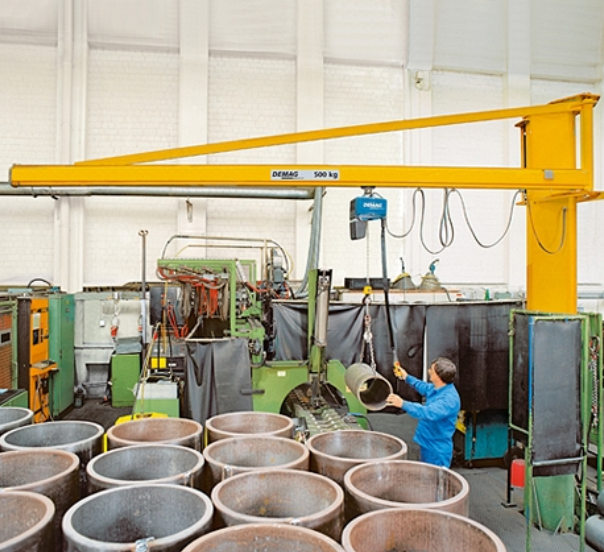
Jib and hoist crane training delivered to operators of any experience level. Courses are available covering training on wall, floor mounted, fully or partially rotating jib arms. Training covering the safe operation of manual and electric hoists is also available nationwide.
Instructions for the safe use of: Slewing Jib Cranes
This document is issued in accordance with the requirements of Section 6 of the Health and Safety at Work etc Act 1974, amended March 1988. It outlines the care and safe use of SLEWING JIB CRANES and is based on Section 9 of the LEEA Code of Practice for the Safe Use of Lifting Equipment.* It should be read in conjunction with the requirements for lifting appliances for general purposes, given overleaf, which form an integral part of these instructions.
This information is of a general nature only covering the main points for the safe use of slewing jib cranes. It may be necessary to supplement this information for specific applications.
ALWAYS:
NEVER:
Type of jib crane - over braced, under braced - floor or wall/column mounted - capacity - height and length.
Slew - angle of slew, 360°, 180° or other - push/pull, hand geared or power slewing.
Type of block and trolley to be used. The need for slewing stops.
Storing and Handling Jib Cranes
When not in use jib cranes should be positioned so as not to present a hazard to persons, goods, vehicles etc that may be in the area. It may be necessary to secure the jib arm to prevent movement taking place as the result of winds etc.
If the jib crane is not in regular use it is advisable to remove the lifting appliance for separate storage. Where this is not possible or desirable the appliance should be parked where it will not present a hazard.
Using Jib Cranes Safely
Do not use defective jib cranes, blocks or accessories.
Position the jib arm carefully. The block hook must be directly over the centre of gravity of the load. Do not use the jib arm or appliance to drag loads along.
Take the load gently and avoid shock loads. Similar care is needed when lowering loads as sudden loading/unloading may cause the jib arm to whip.
Before moving the jib arm or suspended load ensure you have a clear view of the travel path and that this is free of any obstructions etc.
Avoid swinging loads. Push rather than pull on suspended loads. Do not let trolleys crash into the travel stops as the load may whip outward thus increasing the effective radius and therefore the resultant loads imposed on the mechanisms and structure.
In-service Inspection and Maintenance
The maintenance requirements may be combined with those of the lifting appliance.
Lubricate bearings and pivot points. Where the slewing motion is obtained by manual gears or powered drive, the gear wheels and drives must be kept in good order and lubricated.
Bolts and fixings should be checked to ensure they are tight and if necessary re-torqued.
The running surface of the track should be clean and kept free of debris etc.
Regularly inspect the jib crane and, in the event of the following defects, refer the jib crane to a Competent Person for thorough examination: structural defects, damage, distortion or cracked welds; loose or missing bolts; damaged or missing runway end stops; difficulty in slewing or jib arm slews on its own; difficulty in moving trolley or trolley moves on its own; any other visible defects or operational difficulties.
LIFTING APPLIANCES FOR GENERAL PURPOSES
(MANUAL AND POWER OPERATED BLOCKS)
The following information is based on Section 1 - Appendix 1.6 of the Code of Practice for the Safe Use of Lifting Equipment* and should be read in conjunction with the instructions for safe use, given overleaf, of which it forms an integral part and with any specific instructions issued by the supplier.
This information is of a general nature only covering the main points for the safe use of manual and power operated blocks.
ALWAYS:
NEVER:
Types of blocks
A wide range of manual and power operated blocks is available. This section of the leaflet is concerned with matters which are common to the safe use of the following listed equipment when used to lift in a vertical plane only.
Pulley blocks for fibre or wire rope used with winches, hand chain blocks, chain lever hoists, power operated wire rope blocks and power operated chain blocks. The use of trolleys is often associated with blocks and these may be built in with the trolley as an integral part of the appliance, or independent with the block hung on.
Operative Training
Lifting appliances should only be used by trained operatives** who understand their use and that of the associated equipment used in the lift.
Installation and Commissioning
The erection procedure will vary with the equipment and should be carried out in accordance with the suppliers instructions paying attention to the following matters:
Prior to installation inspect the equipment to ensure no damage has occurred in store or transit.
Ensure the support structure is adequate for the full loads that will imposed, is tested and marked with the SWL.
When erecting trolleys ensure they are correctly set for the beam width and that the track is fitted with end stops and remains level at all loads up to the maximum.
When suspending appliances by a top hook ensure the support fits freely into the seat of the hook.
After erection ensure that the chain/wire rope hangs freely and is not twisted or knotted.
With power operated blocks the supply should be connected by a suitably Qualified Person taking account of any statutory or technical requirements (eg Electricity at Work Regulations, Pressure Systems and Transportable Gas Containers Regulations).
Test run to ensure the free and correct movement of the chain/rope. Check the operation of the brake. Check direction of control command, position and operation of travel limits and safety devices.
Safe Use of Blocks
The basic objectives of any lifting operation are to move the load to the desired location and land it safely, efficiently and without damage to the load, the equipment used or the surrounding buildings, plant etc. In addition to any specific instructions relating to the block the following general points must be observed:
In-Service Inspection and Maintenance
The Provision and Use of Work Equipment Regulations 1998 and the Lifting Operations and Lifting Equipment Regulations 1998 both require that lifting equipment properly maintained. This is an ongoing duty that falls on the user and a planned routine maintenance programme will be necessary.
In addition to the statutory thorough examinations by a Competent Person, regular in-service inspections should be made to find any faults and damage that might arise. If any are found they should be referred to the Competent Person.
The maintenance programme must meet the requirements of the manufacturers instructions and any special requirements due to the conditions of service. This may be combined with maintenance of other equipment used in association with the appliance, eg power feed system. Check the block and its associated equipment daily for obvious faults and signs of damage.
Further information is given in: *LEEA Code of Practice for the Safe Use of Lifting Equipment
**HSE Guidance Note GS39 - Training of Crane Drivers and Slingers
Jib Crane Safety Oversights
This article shares what we find to be the most common jib crane safety oversights. There are three basic components to the safe use of a jib crane: a safe hoist, a safe load, and a safe operator. To meet all three conditions, you need a crane that is in good condition with a solid footing. You also need to make sure the load you are attempting to lift is being lifted correctly and does not exceed the capabilities and capacities of the crane. Finally, you need a well-qualified, well rested, sober, and responsible operator who understands the workplace and the task at hand. Once you have all three of these requirements for a safe lift in place, you are ready to run your crane.
However, while we may go down our safety and maintenance checklists every day, one great danger is that many operators lack knowledge from the start. An operator may get a brief time with an experienced operator to show how it works and the rest is on-the-job experience. Some are errors that even the most responsible and experienced crane maintenance and operation crews can fall victim to, as well.
Improper Foundation
One of the biggest dangers is the lack of training and knowledge of the crane’s capabilities, limitations, safe use, and many other factors. This foundation comes from a solid training program including classroom training, hands-on training, and continued monitoring from an experienced operator.
Exceeding Hoist Load
Overloading a jib crane is an easy mistake to avoid. Many operators are not aware of the weight of the load, the capacity of the lifting devices, and other factors such as the method of rigging and center of gravity, which factors into load failures. However, both inexperience and overconfidence can lead operators to overload their cranes. Overloading a crane can be a major temptation toward the end of the day or a long job when you want to get the job done and go home. But doing so can cause dangerous failures.
“Old Reliable” Syndrome
“Old Reliable” syndrome is a danger in any industry where heavy machinery is in regular use, it is especially dangerous when operating cranes. When an operator has been working with a single machine for a considerable amount of time, they may feel that his crane and his skills are infallible. This cavalier attitude leads to misuse, overloading, and maintenance oversights which can lead to serious failure.
Too Expert to Read
Similar to “Old Reliable” Syndrome, when it comes to jib crane safety oversights many times the veteran crane operators who have worked with many cranes over many years think they do not need to read the safety manuals for new cranes. New cranes often come with new configurations and technologies that need specific forms of regular maintenance. Not reading the manual can cause you to overlook an import maintenance step.
Lack of Inspection
Another jib crane safety oversights is daily inspection of a crane, including operating mechanisms, deterioration, load hooks, hoist chains, functional operating mechanisms, and rope reeving are vital. These are the items which must be inspected daily. A failure of any could result in a serious incident. The load chain or wire rope is only one of the critical components.
Daily load chain or wire rope inspection is among the most important parts of maintaining the safe operating condition of your jib crane. Load chain or wire ropes must be visually inspected in addition to a monthly documented inspection. Overlooking jib crane chain inspection is a common hazard on many work sites.
Despite the necessary daily inspections, some of the frequently overlooked safety needs are preventative maintenance and annual inspections. The level of service should be considered when scheduling maintenance, so if the crane is heavily used, then there should be more frequent inspections. However, the absolute minimum for these cranes should include a daily, monthly, and yearly inspection along with preventive maintenance.
Years of experience and accident-free operation can’t guarantee that these mistakes won’t happen. The only guard against dangerous situations is regular training, consistent and thorough inspections and maintenance, and constant vigilance.
Should you have any questions then please do not hesitate to call. We do not offer any training to members of the public — we only offer training to companies.
Four quick steps — we come back the same working day where we can.
Thank you — we'll be in touch shortly.